« Articles
What is Porsche Cayman Model History? Years and Generations


Key Takeaways
- The Cayman launched for the 2006 model year as a fixed-roof, mid-engine sibling to the Boxster.
- Three main generations exist: the 987 (2006–2012), the 981 (2013–2016), and the 718 Cayman (2017 onward).
- Power grew from 245 hp in early base cars to 493 hp in the GT4 RS.
- The 718 Cayman swapped flat-six engines for turbo flat-fours, then brought flat-sixes back in 2020.
- The 987.2 and 981 offer the strongest value for most used buyers.
Here's the thing about the Porsche Cayman: it began as the Boxster's hardtop cousin, then stole the spotlight. Drivers today rave about its balance, its flat-six howl, and the steering that feels almost telepathic on a twisty road. This guide covers the full Porsche Cayman model history, from the very first coupe to the latest cars. You'll get every generation, the key model years, and the details that actually matter when you're shopping.
Porsche Cayman Model History: Where Did it all Begin?
Porsche showed off the Cayman in 2005, building a clever fixed-roof coupe around the Boxster's mid-engine layout. Sales started for the 2006 model year, and that stiffer roofline gave it sharper handling than its open-top sibling. Since then, Porsche has built three generations, and each one has felt faster, sharper, and more polished than the last.
Why Did Porsche Cayman History Begin With the Boxster?
Porsche wanted a fixed-roof sports car priced below the 911, and the Boxster platform was a perfect starting point. A solid roof makes a body much stiffer than a convertible, so steering feels cleaner and corners feel tighter. Plenty of enthusiasts still believe Porsche held back early power so the Cayman wouldn't threaten the pricier 911.
Porsche Cayman Timeline and Porsche Cayman Generations at a Glance
This Porsche Cayman timeline shows how power, design, and personality shifted from one generation to the next. Treat it as a cheat sheet before you dive into the detailed sections below, because the numbers add up fast. Model years follow the US market, so European launch dates sometimes land a year earlier than shown here.
| Generation | Model Years | Main Engines | Peak Power |
| 987.1 | 2006–2008 | 2.7L and 3.4L flat-six | 295 hp (Cayman S) |
| 987.2 | 2009–2012 | 2.9L and 3.4L flat-six | 330 hp (Cayman R) |
| 981 | 2013–2016 | 2.7L, 3.4L, and 3.8L flat-six | 385 hp (GT4) |
| 718 (982) | 2017 onward | 2.0L and 2.5L turbo flat-four, 4.0L flat-six | 493 hp (GT4 RS) |
How Did the Porsche Cayman 987 Begin the Story?
The Porsche Cayman 987 showed up with a stiff body and a mid-mounted flat-six sitting right behind the seats. It came in two phases, 987.1 and 987.2, and the gap between them really shows up in used prices. Once you know the difference, classified ads start making a lot more sense than any glossy photo ever will.
Porsche Cayman 987.1 (2006–2008)
The earliest cars launched as the Cayman S, with a 3.4L flat-six making 295 hp and plenty of torque. A cheaper base Cayman with a 2.7L engine and 245 hp followed soon after for buyers watching their wallets. You could pick a manual gearbox or a Tiptronic automatic, and it's smart to ask for intermediate shaft bearing records.
Porsche Cayman 987.2 (2009–2012)
The 2009 update added direct injection, with a 2.9L engine at 265 hp and a 3.4L S at 320 hp. Porsche also offered the PDK dual-clutch in place of the Tiptronic and dropped the troublesome intermediate shaft design. The Cayman R arrived in 2011 with 330 hp, lighter doors, and a sharper chassis that keen drivers loved.
What Made the Porsche Cayman 981 Special?
The Porsche Cayman 981 debuted for the 2014 US model year, although Europe got it a little earlier. It rode on a longer wheelbase, used more aluminum, and added electric power steering to save fuel. The base car used a 2.7L engine for 275 hp, while the S used a 3.4L engine for 325 hp.
The GTS arrived for 2015 with 340 hp, and the 2016 Cayman GT4 delivered 385 hp from a 3.8L engine. That GT4 came with a six-speed manual only, and it's now one of the most collectable Caymans ever built.
Also Read: Porsche 911 History: How Has the Icon Changed Since 1963?
How Did the Porsche 718 Cayman Change the Formula?
The Porsche 718 Cayman arrived for 2017 with the 982 code and a name borrowed from a classic racing car. Porsche replaced the flat-six with a turbocharged flat-four, which brought more torque but split opinion on sound. The 2.0L base engine made 300 hp, the 2.5L Cayman S made 350 hp, and both felt quicker than before.
Porsche 718 Cayman Trims and Special Models
The 718 line grew into a big family, and each trim chased a different kind of driver:
- Cayman T: a lighter, purist trim built around the 300 hp 2.0L engine.
- Cayman GTS (2018): a 2.5L turbo making 365 hp with extra sport tuning.
- Cayman GTS 4.0 (2020): a 4.0L flat-six making 394 hp.
- Cayman GT4 (2020): a 4.0L flat-six making 414 hp, with track-ready suspension.
- Cayman GT4 RS (2022): the most extreme version, making 493 hp.
The naturally aspirated 4.0L flat-six returned in 2020, which thrilled fans who'd missed that classic Porsche sound.
What Comes After the 718 Cayman?
Porsche has confirmed that the combustion-powered 718 is ending, and an electric successor is planned for a future launch. Reports say the launch timing has shifted several times, so check Porsche's official channels for the latest details. Some analysts expect the last combustion Caymans to hold their value well as electric replacements get closer to showrooms.
How Did Porsche Cayman Evolution Shape the Car?
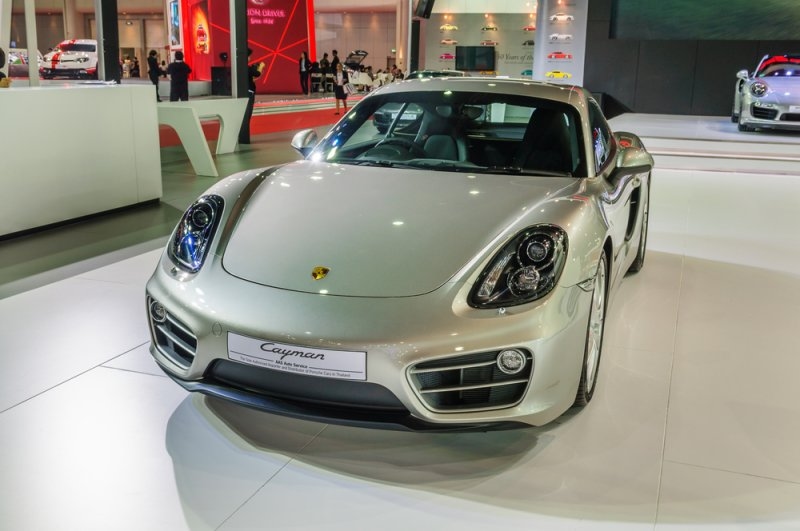
The Porsche Cayman evolution follows a clear pattern: more power, more tech, and tighter handling with nearly every update. Each step made the car faster and easier to live with, though purists still grumble about the lost hydraulic feel. Weight stayed near 3,000 pounds across all generations, so every Cayman still feels light, agile, and engaging.
| Area | 987 | 981 | 718 |
| Steering | Hydraulic | Electric | Electric |
| Engine | Naturally aspirated flat-six | Naturally aspirated flat-six | Turbo flat-four, later flat-six |
| Gearbox | Manual, Tiptronic, or PDK | Manual or PDK | Manual or PDK |
| Infotainment | Basic screen | Touchscreen system | Larger screen with Apple CarPlay |
Which Porsche Cayman Model Years are Best to Buy?
The best Porsche Cayman model years depend on your budget, your taste, and how much maintenance you can stomach. Use these quick picks to match a generation to your priorities:
- Budget pick: the 2009–2012 987.2 for revised engines and the PDK option.
- All-rounder: the 981 for a modern feel and lower running costs.
- Modern performance: the 718 Cayman S or GTS for strong turbo power.
- Collector pick: the 981 GT4, 718 GT4, and GT4 RS.
Always ask for full service records, a pre-purchase inspection, and proof of any major engine work before you pay.
Must Try: Porsche 918 Spyder vs 2026 911 Turbo S: Key Differences
Conclusion
The Porsche Cayman model history shows a car that kept getting faster without losing its balanced, mid-engine charm. From the 987 coupe to the 718 Cayman, every generation brought real upgrades and a personality all its own. Pick the generation that fits your budget, inspect the car carefully, and then go enjoy a wonderfully balanced sports car.
FAQs
What is the Porsche Cayman model history in brief?
The Cayman launched for 2006 as a fixed-roof Boxster sibling, then evolved through the 987, 981, and 718 generations, gaining power, technology, and track-focused GT4 variants along the way, while keeping its mid-engine balance.
How many Porsche Cayman generations are there?
There are three main Porsche Cayman generations: the 987 from 2006 to 2012, the 981 from 2013 to 2016, and the 718 Cayman, also called 982, from 2017 onward. Each generation also received mid-cycle updates.
What is the difference between the Porsche Cayman 987 and 981?
The 981 is longer, stiffer, and uses electric power steering, while the 987 keeps hydraulic steering. The 981 also offers more power, better efficiency, and a more modern, comfortable interior for daily use.
Is the Porsche Cayman 987.2 a safer buy than the 987.1?
Many buyers prefer the 987.2 because Porsche redesigned its engines, removing the intermediate shaft bearing concern found on earlier cars. A pre-purchase inspection remains essential for every used Cayman, regardless of year.
What does 987 mean on a Porsche Cayman?
987 is Porsche's internal type code for the first Cayman generation, built from 2006 to 2012. Porsche also uses codes like 981 and 982 to separate later generations and their major updates.
Featured Video
The fastest Porsche 911 ever made | Turbo S
The Porsche 911 has a turbo boost button but you only have 20 seconds...
Comment using Facebook